
⭐⭐⭐⭐⭐
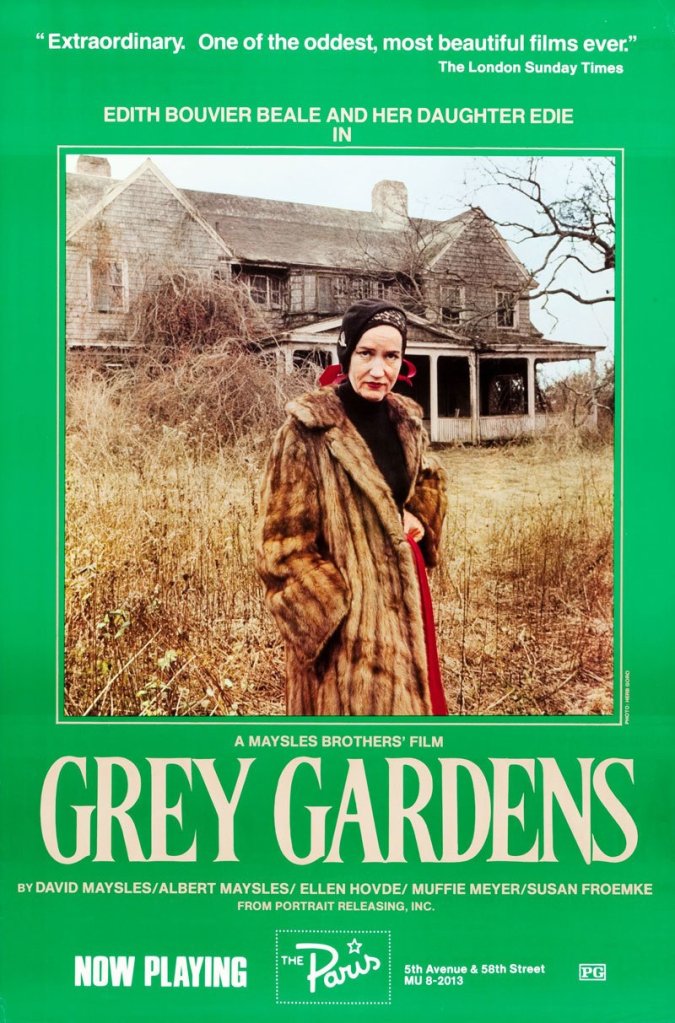
The documentary Grey Gardens is a deeply personal and haunting look into the lives of two extraordinary women — Edith Bouvier Beale, or “Big Edie,” and her daughter, Edith “Little Edie” Bouvier Beale. Living in a crumbling mansion in East Hampton, the Beales are a fascinating contradiction. Once part of the American aristocracy and relatives of Jacqueline Kennedy Onassis, they now exist in a world of faded grandeur, surrounded by overgrown gardens, raccoons, and the ghosts of their past. Directed by Albert and David Maysles, the film captures their eccentric, isolated lives with an intimacy that is both captivating and heartbreaking.
Big Edie, a former singer whose voice still carries echoes of its former beauty, spends her days reminiscing about her youth and the life she once led. Little Edie, at 56, is a dreamer who never stopped believing in the possibility of something more. Her makeshift outfits — turbans made from sweaters, skirts worn upside down — are as much a testament to her creativity as they are to her circumstances. Watching her, I felt a mix of admiration and sadness. She is sharp, witty, and undeniably intelligent, but there’s something deeper beneath the surface. Though it’s never openly discussed, Little Edie’s behavior hints at struggles with mental health. Her erratic thoughts, bursts of paranoia, and obsessive focus on her unfulfilled dreams suggest a woman grappling with more than just loneliness. It’s heartbreaking to see someone so vibrant and full of potential weighed down by these invisible battles.
The Maysles brothers, known for their unobtrusive documentary style, allow the Beales to take center stage without interference. The film feels less like a documentary and more like a window into their world. The Beales are not just subjects. They are performers, fully aware of the camera’s presence and using it to tell their own stories. Little Edie, in particular, seems to thrive under its gaze, treating it as both a confidant and an audience. This dynamic blurs the line between reality and performance, making the film feel like a collaboration rather than an intrusion.
Since its release in 1975, Grey Gardens has become a cultural phenomenon, inspiring a Broadway musical, an HBO film, and countless homages in fashion and pop culture. Little Edie’s unique style and larger-than-life personality have made her an icon, celebrated for her individuality and resilience. But beyond its cult status, the film resonates on a deeply human level. It’s a story about family, identity, and the passage of time, told through the lens of two women who refuse to conform to societal expectations.
For me, Grey Gardens is more than just a documentary. It’s an emotional experience. Little Edie’s vulnerability and unyielding spirit struck a chord with me in a way few films ever have. Her dreams, though unfulfilled, are a testament to her enduring hope and creativity. At the same time, her struggles with mental health add a layer of complexity that makes her story all the more poignant. The film doesn’t just document the Beales’ lives. It invites us to reflect on our own choices, relationships, and the paths we take.
If you’ve never seen Grey Gardens, I can’t recommend it enough. It’s a film that will make you laugh, cry, and think deeply about the complexities of human existence. The Beales’ story is a reminder of the beauty, fragility, and resilience that can be found even in the most unexpected places.
Copyright ©️2026 by Frank Gaimari
Frank Gaimari is an author and film reviewer in Seattle, where he lives with his husband and their two golden retrievers. You can learn more about his work at http://www.FrankGaimari.com.

 FRANK'S FILM REVIEW