
⭐⭐⭐⭐⭐
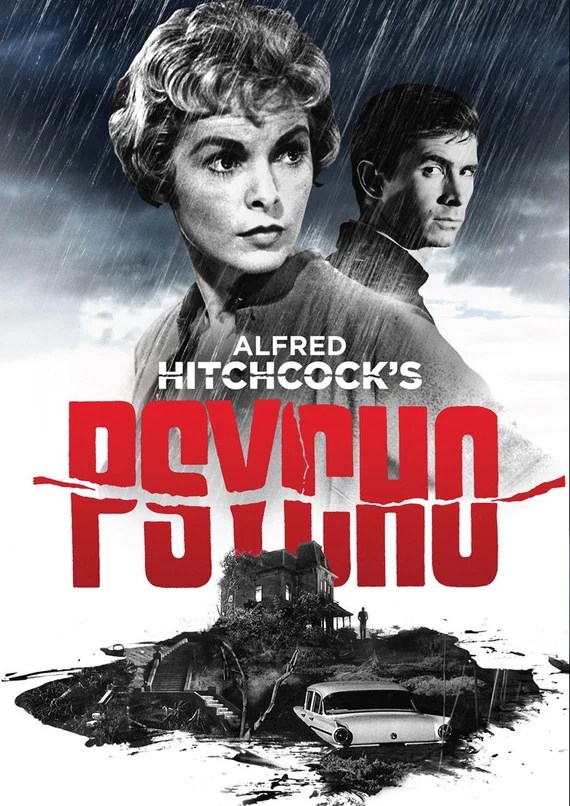
This Halloween, I found myself alone with nothing but silence and a craving for cinematic chills, so I settled in and pressed play on one of my all-time favorites. No matter how many times I revisit Hitchcock’s classic film Psycho, it never loses its hold on me. The film immediately casts its spell, opening in a dimly lit hotel room where Marion Crane (Janet Leigh) and her lover, Sam Loomis, share a stolen afternoon. The air is thick with intimacy — John Gavin’s Sam is bare-chested and magnetic. In 1960, this glimpse of an extramarital affair — and a woman unapologetically dressed in her undergarments — was nothing short of daring. From the very first scene, desire and secrecy pulse beneath the surface, setting the tone for the suspenseful unraveling that follows.
The story centers on Marion, trapped in a stagnant life and separated from Sam because of his debts. In a desperate attempt to find freedom, she impulsively steals $40,000 from her employer and leaves town, hoping to start a new life with her lover. Marion isn’t a hardened criminal; she’s simply reaching for a happiness that always seems just out of reach. Her flight leads her to the Bates Motel, where she meets Norman Bates — played by Anthony Perkins. Norman’s boyish smile and awkward politeness hide a deep loneliness; his gentle demeanor is shadowed by something darker beneath the surface. Perkins gives Norman a mix of vulnerability and menace, making him a character you want to protect — and fear — all at once.
Hitchcock’s control is absolute. From Saul Bass’s fracturing title sequence to the relentless precision of the editing, every frame is designed to create a sense of unease. He uses misdirection like a weapon, forcing us to become voyeurs alongside Norman, peering through peepholes and becoming complicit in his transgressions. When the chaos erupts, it’s not just the violence that shocks, but Bernard Herrmann’s iconic all-strings score. Those shrieking violins are the sound of a psyche tearing itself apart. The film’s second half, driven by the dogged determination of Marion’s sister Lila (Vera Miles), shifts from a story of escape to a chilling investigation of what lies beneath a placid surface.

Remarkably, Psycho was created on a modest budget of $800,000. Despite its limited resources, the film earned about $32 million in the United States and an estimated $50 million worldwide. Psycho proved that a well-crafted thriller could become a box office sensation. The film also broke new ground by killing off its lead character halfway through and delving into psychological themes that mainstream movies hadn’t explored before.
More than sixty years later, Psycho feels more modern than ever. It’s a film that understands the terror of repression and the danger of the secrets we keep, even from ourselves. It reminds us that sometimes the most terrifying things aren’t the monsters in the dark, but the quiet desires hiding in plain sight.
Copyright ©️2025 by Frank Gaimari
Frank Gaimari is an author, film reviewer, and actor based in Seattle, Washington. He lives with his husband and their two golden retrievers. Learn more about his work at http://FrankGaimari.com.


 FRANK'S FILM REVIEW